
Quick answer: Answering service costs run $99/mo (basic) to $1,695+/mo (premium live). The billing model — per-minute, per-call, or flat-rate — drives the bill more than the sticker price. Pick the model that fits your call durations, not the lowest base rate.
Answering Service Costs Compared: What You'll Actually Pay in 2026
Answering service costs range from $99/month for a basic plan to $1,695+/month for premium live receptionists. The spread is massive because billing models vary wildly: per-minute, per-call, and flat-rate plans each hit your budget differently depending on call volume.
Most business owners discover the true cost only after their first bill arrives. A "$199/month" plan with per-minute overages can run $600+ once you exceed the included minutes. According to a study by 411 Locals, businesses only answer 37.8% of their inbound calls on average, and with 67% of callers refusing to leave voicemails, the cost of NOT having an answering service is even higher.
But cost alone doesn't tell you what you're getting. This guide breaks down what answering services actually cost across billing models, compares 5 leading providers with real math at realistic call volumes, and exposes the hidden fees that inflate your bill. The 2025 Gartner Magic Quadrant highlights leaders and emerging trends in unified communications, with AI integration becoming a key differentiator in pricing.
What Does an Answering Service Cost?
Before comparing specific providers, here is the pricing landscape at a glance:
| Tier | Monthly Cost | What You Get |
|---|---|---|
| Basic | $99-$199/mo | Limited minutes (20-75), basic message taking, business-hours coverage |
| Mid-Tier | $245-$400/mo | 100-200 minutes, appointment scheduling, CRM integration, 24/7 option |
| Premium | $500-$1,695+/mo | Dedicated receptionists, high-volume minutes, regulatory compliance, full integrations |
| AI Flat-Rate | $199/mo | Unlimited calls, 24/7 coverage, all features included, no overages |
The tier you land in depends on three factors: your monthly call volume, whether you need live humans or AI handles your call types, and how many add-on features you require.
Answering Service Billing Models Explained
The billing model matters more than the base price. Here is how each model works and who it favors.
Per-Minute Pricing
You pay for every minute an agent spends on your calls, on top of a base fee. Rates range from $0.75 to $2.00 per minute. Short calls are cheap; longer calls add up fast. Watch for rounding increments — some providers round to the nearest 30 or 60 seconds.
Best for: Very low volume businesses (under 30 calls/month) where calls genuinely run 2+ minutes end-to-end.
The trap: A 50-call month averaging 2.5 minutes per call at $1.50/minute plus a $200 base fee totals $387 — nearly double the advertised rate. And that assumes your calls actually average 2.5 minutes; most service-business call mixes run shorter and get hit harder by the rounding.
Per-Call Pricing
A flat fee per call regardless of duration, typically $1.50-$8.50 per call. More predictable than per-minute, but every call counts equally — including wrong numbers, hang-ups, and spam. In our post-2026-05-16 sample, 9.0% of inbound calls were spam — a per-call vendor charges you for every one of those unless they filter for free.
Best for: Businesses with longer average calls (3+ minutes) at moderate volume, where the per-minute meter would run worse than the flat per-call fee.
The trap: At $8.50/call, 100 calls/month costs $850 in per-call fees alone — before the base fee.
Flat-Rate / Unlimited Pricing
One monthly price regardless of call volume. No overages, no per-minute tracking. Your busiest month costs the same as your slowest.
For a deeper look at the flat rate vs per-minute tradeoff, see our dedicated comparison.
How the major providers price (snapshots dated 2026-05-26)
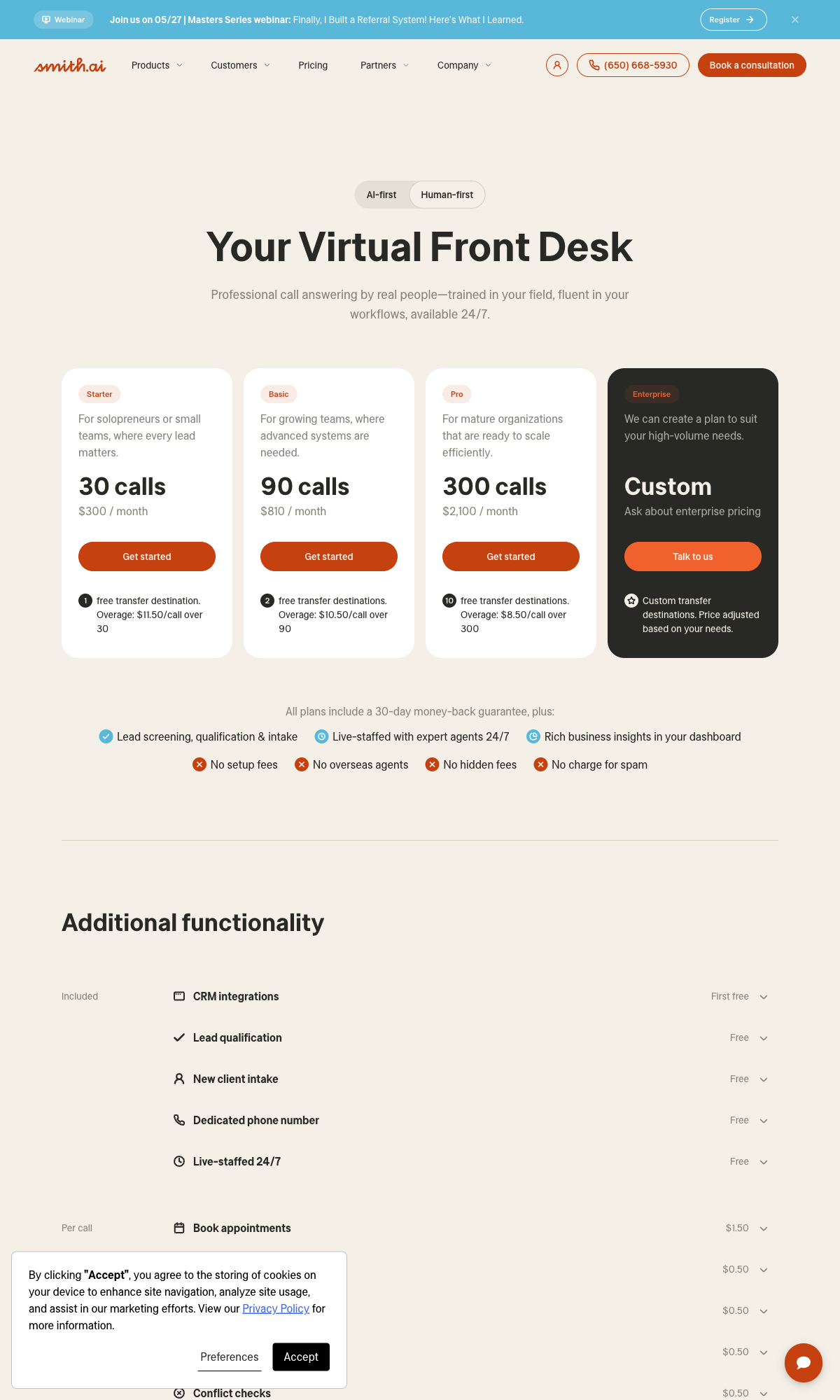
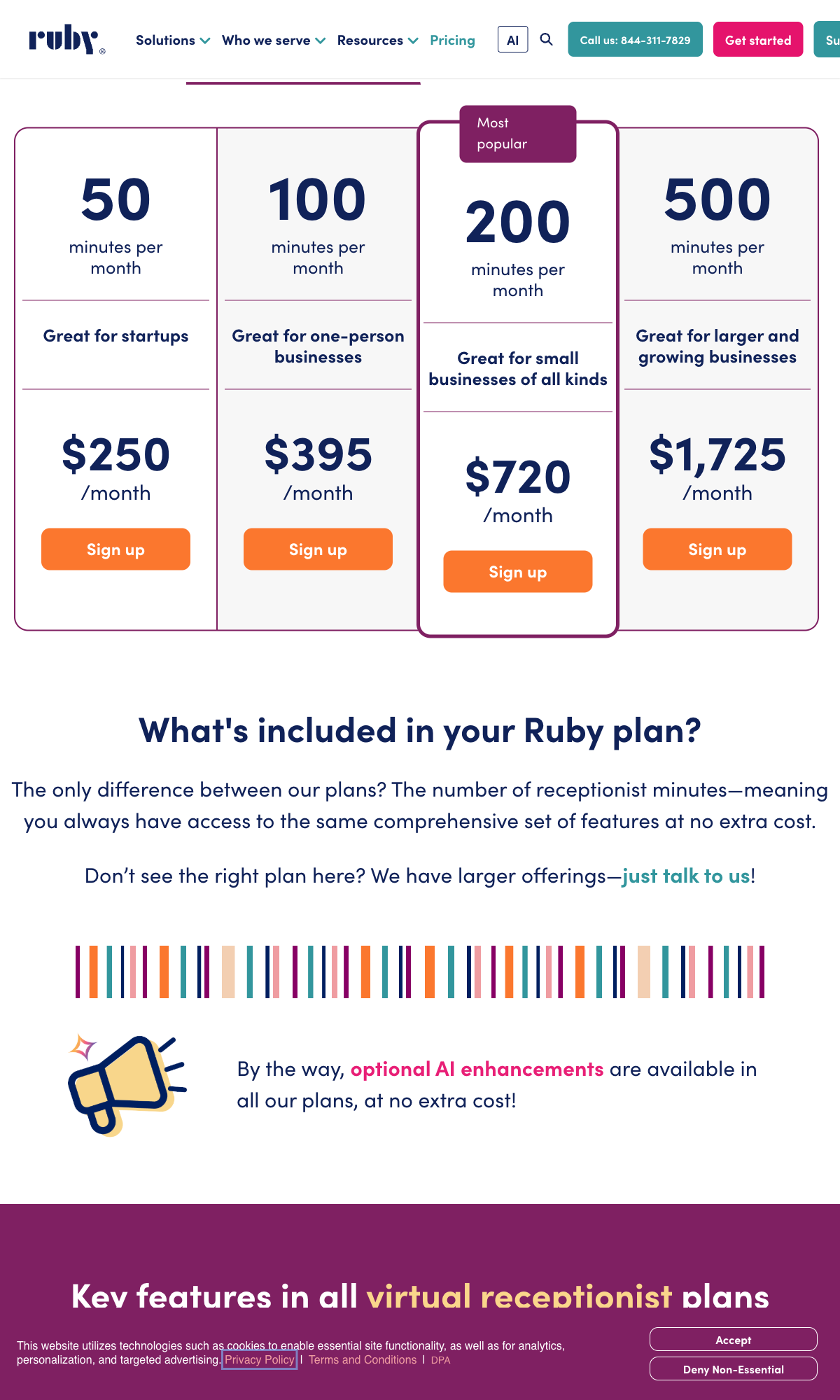
Pricing changes quarterly. Below are screenshots captured directly from each vendor's published pricing page on 2026-05-26 — verify the math yourself instead of trusting our summary.
NextPhone — Flat-rate $199/month for unlimited inbound calls and 24/7 coverage. No per-minute meter, no per-call charge, no overage tier — the only flat-rate AI receptionist in this lineup.
| Plan | Price | Calls included | Overage |
|---|---|---|---|
| NextPhone Pro | $199/mo | Unlimited | None |
Types of Answering Services Explained
Before diving into specific providers, understanding the three main categories of answering services will help frame your decision.
Traditional Live Answering Services
Live answering services employ real human receptionists who answer calls on behalf of your business. These professionals work from call centers and are trained to follow your scripts, capture caller information, schedule appointments, and transfer calls as needed.
Most live services charge per minute or per call, with monthly packages that include a set number of minutes. Overages are common and can significantly increase costs. The primary advantage is the human touch—callers interact with a real person who can demonstrate empathy, handle nuanced situations, and adapt to unexpected requests.
Leading live answering services include Ruby Receptionists, AnswerConnect, Moneypenny, and the human tier of Smith.ai.
AI-Powered Answering Services
AI answering services use natural language processing and machine learning to handle calls automatically. Modern AI systems can understand caller intent, answer questions, schedule appointments, route calls, and capture information—all without human intervention.
The cost structure typically favors flat-rate pricing or lower per-call fees, making AI services more economical for businesses with high call volumes. AI also handles unlimited simultaneous calls, meaning no caller ever gets a busy signal or waits on hold.
The tradeoff is the lack of human connection. While AI has improved dramatically (see our AI vs human receptionist and AI receptionist vs answering service comparisons), some callers still prefer speaking with a person, especially for complex or emotionally sensitive matters.
A real inbound qualification call — contact info, urgency, and scope captured before the caller can hang up. This is the routine call mix that drives the bill on per-minute services.
Hybrid Solutions
A growing category combines AI efficiency with human backup. These services use AI to handle routine calls while routing complex situations to live receptionists. This approach balances cost control with the ability to provide human touch when needed.
Smith.ai pioneered this model with their AI receptionist tier that seamlessly escalates to human agents when necessary.
Top Answering Services Compared
Let's examine the leading answering services across both live and AI categories.
Ruby Receptionists
Ruby has built its reputation on premium, U.S.-based live receptionist service since 2003. Every call is answered by a trained professional working from Ruby's facilities, never offshore call centers.
Pricing:
- Starting at $319/month plus $5.19 per call
- Plans range from $245/month (50 minutes) to $1,695/month (500 minutes)
- Bundled plans with live chat available at 25% discount
- 100% U.S.-based receptionists
- 24/7 availability
- Mobile app for call management
- Custom call handling scripts
- Voicemail transcription
Pros:
- Consistently high service quality
- Strong brand reputation
- Reliable around-the-clock coverage
- Excellent training programs for receptionists
The reality: You're paying $319 base plus $5.19 per call—even "What time are you open?" costs you $5.19. At 100 calls/month, you're at $800+.
Smith.ai
Smith.ai differentiates itself with a hybrid approach offering both AI and human receptionist options, plus a unique per-call (rather than per-minute) pricing model.
Pricing:
- AI Receptionists: $97.50/month for 30 calls
- Human Virtual Receptionists: $292.50/month for 30 calls
- Live Chat: $140/month for 20 chats, up to $600/month for 120 chats
- Overage rates: $3.25/call (AI) or $9.75/call (human)
Key Features:
- Per-call pricing provides cost predictability
- Free spam call filtering (no charges for unwanted calls)
- AI tier with seamless human escalation
- Extensive CRM integrations (Salesforce, HubSpot, Clio, Zapier)
- Outbound calling capabilities
Pros:
- Predictable per-call costs (no timing concerns)
- No charges for spam, wrong numbers, or sales calls
- Flexibility to choose AI, human, or hybrid
- Strong technology integrations
Cons:
- Human tier becomes expensive at higher volumes
- Per-call overage fees add up
- Requires choosing between AI and human tiers
The hybrid tax: You're paying $292.50/month for 30 calls, then $9.75 per additional call on the human tier. At 100 calls/month, that's $292.50 + $682.50 = $975/month. The AI tier is cheaper but still per-call pricing — you pay the same $3.25 for a 5-second wrong number and a 4-minute intake.
AnswerConnect
AnswerConnect positions itself as a human-first service—no AI, no bots, just trained receptionists answering calls. Forbes named them the #1 Answering Service in 2025.
Pricing:
- $325/month for 100 minutes
- $2.95 per additional minute
- $75 setup fee
- No extra charges for nights, weekends, or holidays
Key Features:
- 24/7/365 live answering with no upcharges
- 99.43% of calls answered within 1-4 rings
- 25+ platform integrations
- Bilingual English/Spanish service
- Message taking, appointment scheduling, lead capture
Pros:
- Exceptional reviews (4.8/5 on Trustpilot, 4.7/5 on G2)
- Consistent human touch on every call
- Transparent pricing with no weekend surcharges
- Strong answer rate performance
Cons:
- Per-minute pricing escalates with longer or more calls
- No AI option for cost-conscious users
- Setup fee required
- Canadian company (some pricing in CAD)
The per-minute problem: $325 base + $2.95/minute overage. Your busiest month also becomes your highest bill: success punishes you.
Moneypenny
With over 24 years in business and more than 20 million calls answered, Moneypenny brings deep experience, particularly in serving legal sectors. They serve regulated industries that require strict compliance.
Pricing:
- Essential Plan: $99/month for 30 minutes (~$3.30/minute)
- Personalized Plan: $189/month with CRM integration
- Overage: $2.99/minute
- Setup fee: $1,000 (includes 500 free minutes)
- Live chat: $75/month add-on
Key Features:
- Industry-specific compliance
- Unlimited caller information capture
- Dedicated receptionist option
- Legal sector expertise
- Live chat service available
Pros:
- Long track record of reliability
- Industry-specific expertise and compliance
- Dedicated receptionist builds familiarity with your business
Cons:
- High setup fee ($1,000)
- Per-minute overages escalate quickly during busy periods — and worse if rounding pads short calls
- Pricing lacks transparency—requires contacting sales
- Low included minutes mean frequent overages
The compliance premium: $1,000 setup fee plus low included minutes (30 min = ~15 calls if your average is 2 minutes; far fewer billed minutes on a short-call mix once rounding is applied) means you'll hit overages immediately.
NextPhone AI Answering
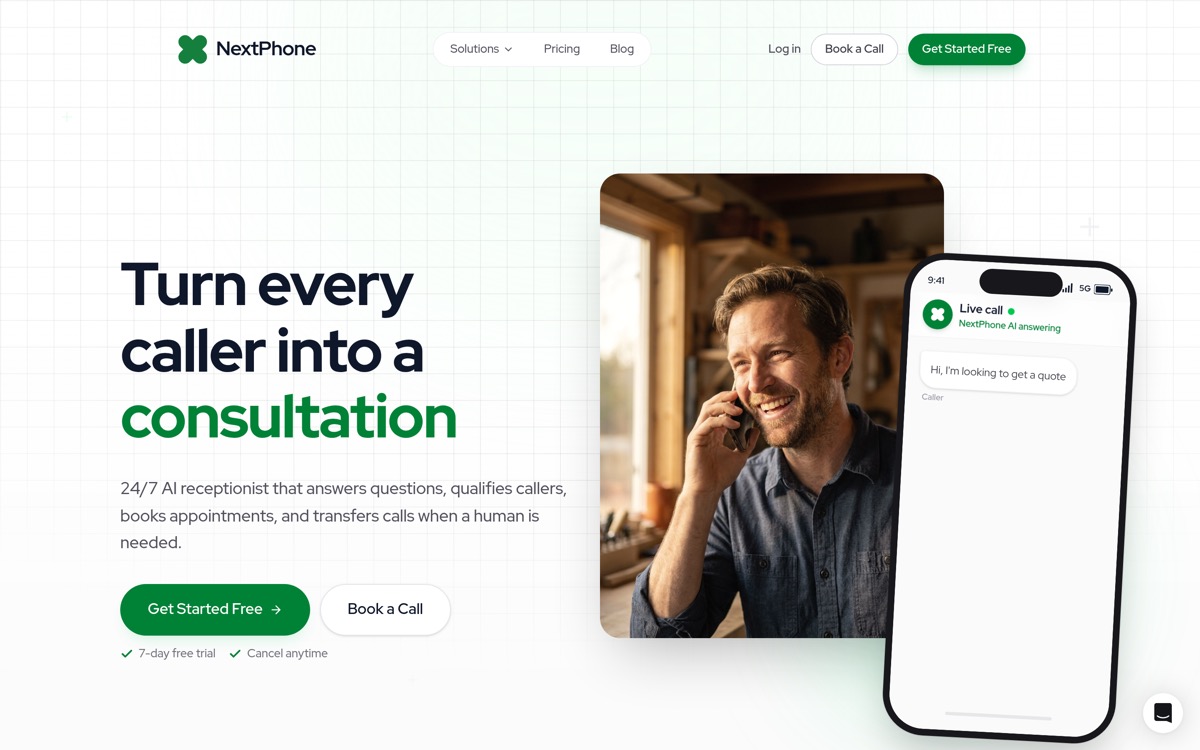
NextPhone takes a different approach with flat-rate AI answering that includes unlimited calls. Instead of worrying about minutes or per-call fees, businesses pay one predictable monthly price.
Pricing:
- $199/month flat rate
- Unlimited calls included
- No per-minute or per-call charges
- No setup fees
Key Features:
- Answers in 1 ring (3x faster than call centers taking 3-5 rings)
- 9 languages included at flat rate—Spanish, French, Portuguese, German (competitors charge $6-8 extra per Spanish call)
- Frontier AI technology built on latest GPT and Claude models (not legacy IVR)
- Trained on YOUR business—learns from your website, knows YOUR services and pricing (not generic scripts)
- Unlimited simultaneous calls—handles surges without capacity limits
- 24/7 AI-powered answering
- Live in 1-2 days—no weeks of operator training
- Appointment scheduling and calendar integration
- 100+ integrations—automatic CRM logging
- Custom greeting and call flow setup
- Selectable voice library — 30+ production voices, every one auditionable
And you can pick the voice. Every voice in the production library is selectable in the assistant config:
Default pick for client-facing intake — friendly, organized, trustworthy.
Default male pick for B2B service businesses. No fluff, no upspeak.
For bilingual lines, no per-Spanish-call surcharge.
The obvious choice for: Any business handling 100+ calls/month. Contractors needing 24/7 emergency coverage. Anyone tired of per-minute billing surprises. Businesses serving multilingual customers. Literally anyone answering routine calls (hours, pricing, scheduling) — which is 80% of businesses.
Try NextPhone free for 7 days
AI answering service that answers, qualifies, and books — 24/7.
Get Started FreeAnswering Service Comparison Table
| Feature | Ruby | Smith.ai | AnswerConnect | Moneypenny | NextPhone |
|---|---|---|---|---|---|
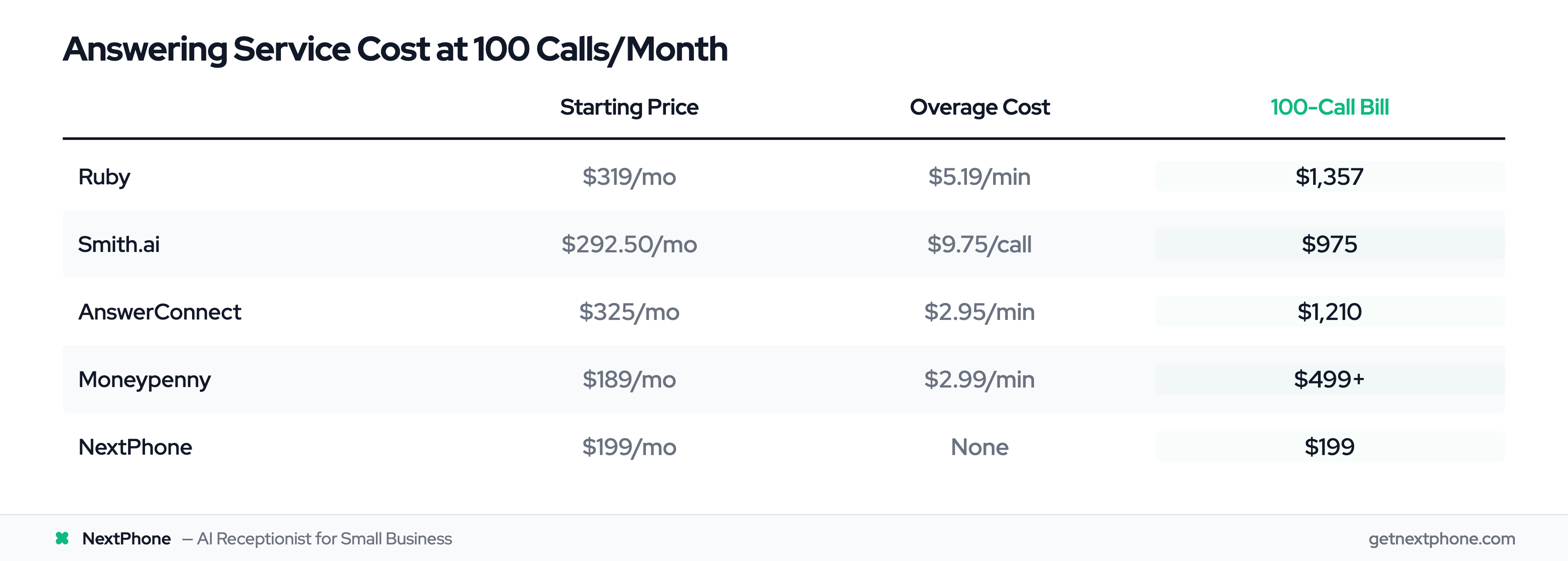
| Monthly Starting Price | $319 | $292.50 | $325 | $189 | $199 |
| Pricing Model | Per-call | Per-call | Per-minute | Per-minute | Flat rate |
| Included Calls/Minutes | Varies by plan | 30 calls | 100 minutes | 30 minutes | Unlimited |
| Overage Cost | $5.19/call | $9.75/call | $2.95/min | $2.99/min | None |
| Rounding Increment | 30s | n/a (per call) | 60s typical | 60s typical | n/a (flat) |
| Setup Fee | None | None | $75 | $1,000 | None |
| 24/7 Availability | Yes | Yes | Yes | Yes | Yes |
| Live Human Receptionists | Yes | Yes | Yes | Yes | No (AI) |
| AI Option | No | Yes | No | No | Yes |
| CRM Integration | Limited | Extensive | 25+ tools | Yes | Yes |
| Bilingual | Limited | Yes | Yes | Yes | Yes |
| Best For | Premium service | Flexibility | Human-first | Regulated industries | Cost control |
Match the billing model to your call mix
Pricing comparisons usually ask "AI vs live." The more useful question is: does your call mix favor per-minute, per-call, or flat-rate? Three call-mix archetypes show up over and over in our data.
Archetype A — Short, frequent, after-hours-heavy (most service businesses)
Flat-rate is the rational fit. The whole reason flat-rate exists is to neutralize the rounding game and the after-hours surcharge.
Archetype B — Long, deliberate, low-volume (some legal intake, complex B2B)
If your average call genuinely runs 3-5 minutes (long intake, detailed scoping) and you're under ~40 calls/month, per-call pricing can win — you're paying a fixed fee for a call that would have run up the meter on per-minute. Smith.ai's $9.75/call human tier is one of the few that holds up at this profile.
Archetype C — Medium-length, predictable, mid-volume
The murky middle — 60-200 calls/month averaging 1-2 minutes — is where every vendor's calculator gives a different answer. The deciding variable is usually after-hours and weekend share.
The cost reality
Understanding true costs requires looking beyond base monthly fees:
In-house receptionist: $35,000-$45,000/year including salary, benefits, and overhead. Limited to one person handling one call at a time, with breaks, sick days, and vacation. For comparison, major business phone providers like RingCentral charge $20-$35/user/month for their UCaaS platforms — showing how technology has shifted the cost equation.
Live answering services: $300-$2,000+/month depending on volume. A business receiving 300 calls averaging 2 minutes each would use 600 minutes — well beyond most included packages, triggering significant overages. If the vendor rounds to 60 seconds, you also pay for whatever fraction of a minute every call ate up.
AI answering services: $99-$300/month typically flat rate. The same 300-call scenario costs the same as 50 calls.
Real-World Cost by Business Type
Abstract pricing ranges do not tell you what YOUR business will pay. Here are three common scenarios with actual math.
Scenario 1: Plumbing contractor — 150 calls/month A plumber receiving 150 calls/month with 2.5-minute average calls needs 375 minutes. With AnswerConnect ($325 base, 100 included minutes, $2.95/min overage), that is $325 + (275 × $2.95) = $1,136/month. With NextPhone at $199/month flat-rate, the savings are $937/month or $11,244/year. If the call mix is shorter (closer to our 17.3s median), per-minute rounding makes the gap wider, not narrower.
Scenario 2: HVAC company — 200 calls/month (seasonal peaks to 400) An HVAC business averaging 200 calls/month with summer surges to 400. With Ruby ($319 base, 50 included minutes), even at 200 calls that is $319 + (450 min × $5.19) = $2,655/month in peak season. With flat-rate AI, peak and off-peak cost $199/month — saving $2,456/month when it matters most. Plus: HVAC calls cluster around heatwaves and outages, which means a heavy after-hours skew that piles on top of the surge.
Scenario 3: Law firm — 80 calls/month, complex intake A law firm with 80 calls/month where 30% require human judgment. Smith.ai at $255 base + (50 overage calls × $8.50) = $680/month for human agents on every call. Alternative: AI handles 56 routine calls (scheduling, basic questions), forwards 24 complex calls to staff — $199/month total. Even adding a part-time paralegal for complex intake costs less than full live service.
How to Choose the Right Answering Service
Assess Your Call Volume AND Duration
Before comparing services, understand your current call patterns:
This data reveals which pricing model—per-minute, per-call, or flat-rate—serves you best. Don't trust calculators that only ask for "average call length" — the median is what gets multiplied by your call count, and the rounding is what bloats it.
Understand Your Call Complexity
Categorize the types of calls you receive:
- Simple: Hours inquiries, basic info, appointment scheduling
- Moderate: Sales questions, service requests, general support
- Complex: Legal intake, regulated-industry triage, emotional situations, complaints
If most calls are simple or moderate, AI handles them capably. Complex calls may require human judgment.
Set Your Budget
Calculate what missed calls cost your business today. If your average customer is worth $500 and you miss 20 calls monthly that would have converted, that's $10,000 in lost revenue — making even premium answering services cost-effective.
Determine your acceptable monthly investment, but account for the true total cost including:
- Base monthly fee
- Likely overages based on your volume and the vendor's rounding rule
- Setup fees
- Add-on features you'll need
Evaluate Integration Needs
Modern answering services should connect with your existing tools:
- CRM systems (Salesforce, HubSpot, Zoho)
- Calendar applications (Google Calendar, Calendly)
- Practice management software (Clio for legal, industry-specific tools)
- Communication platforms (Slack, email)
Verify that your chosen service integrates with your tech stack before committing.
Hidden Answering Service Fees to Watch For
The advertised price is rarely what you pay. These hidden costs can add 25-60% to your expected monthly bill.
Per-minute rounding. This is the biggest one and the least talked about. Always ask: "What billing increment do you use?" — and if the answer is 60 seconds, plan your math against your median call duration, not the vendor's calculator default.
Spam call billing. Per-call and per-minute providers charge for every answered call — including robocalls, wrong numbers, and spam. In our sample, 9.0% of inbound calls were spam. At $5-$8 per call, 10 spam calls/month adds $50-80 to your bill for zero value. Good services filter spam automatically at no charge.
Setup fees ($75-$1,000). Moneypenny charges $1,000 for onboarding. AnswerConnect charges $75. NextPhone and Smith.ai charge nothing. This fee amortizes across months, but at $1,000, it is equivalent to 5 months of a flat-rate AI service.
Holiday surcharges (1.5x-2x rates). Live services often charge premium rates on 11 federal holidays plus weekends. That "$1.00/minute" rate becomes $1.50-$2.00 exactly when after-hours coverage matters most. Weekend calls compound the surcharge math when live services apply premium rates.
The "13th invoice" billing practice. Some providers bill on 28-day cycles rather than monthly, generating 13 invoices per year instead of 12. Read the billing terms carefully.
Feature add-ons ($10-$100/month each). Call recording, CRM integration, bilingual support, voicemail transcription, and appointment scheduling are often priced as add-ons. A "$199/month base" can become $300-400/month with the features you actually need.
How to Reduce Your Answering Service Costs
Audit your actual call volume AND median duration first. Track inbound calls for 30 days before choosing a plan. Most businesses overestimate average minutes (rare long calls drag the mean up) and underestimate total call count. Look at the median — that's what gets multiplied through the rounding rule.
Use AI for routine calls. If 80% of your calls are scheduling, basic questions, and message-taking, AI handles these at a fraction of live service cost. Reserve human agents for the 20% that require judgment.
Filter spam before it hits your bill. Services that charge per-call or per-minute bill you for spam. Either choose a provider with built-in spam filtering or add a spam filter upstream.
Go flat-rate at 50+ calls/month — sooner if your calls are short. The math is consistent: once you exceed 50 calls monthly, flat-rate pricing beats per-minute and per-call models. The cost advantage grows with volume AND with how short your calls are.
What to Avoid When Choosing an Answering Service
Navigate the selection process carefully by watching for:
Hidden fees and setup costs. Some providers advertise low monthly rates but charge $500-$1,000+ for setup, training, or configuration. Ask for complete pricing upfront.
Aggressive per-minute rounding. Services that round to the nearest minute or 30-second increment inflate costs significantly on short calls. A 15-second call rounded to 60 seconds costs 4x what you actually used.
Charges for unwanted calls. Quality providers filter spam and don't charge for wrong numbers. Others bill for every call regardless of legitimacy.
Long-term contracts. Month-to-month flexibility allows you to switch if service quality declines. Be wary of annual commitments with cancellation penalties.
Poor response time guarantees. The best services answer within 3-4 rings. Ask about their average speed of answer and hold time metrics.
Mismatched compliance. If you're in legal or financial services, verify the provider meets your compliance requirements (attorney-client privilege protections, etc.) before signing.
Frequently Asked Questions
How much does an answering service cost?
For a deeper dive, see our complete answering service cost guide. Answering service pricing varies widely based on the type and volume. Basic AI services start around $99/month, while premium live receptionist services range from $245 to $1,695+ per month. Flat-rate services charge a fixed monthly price for unlimited calls.
What's the difference between a virtual receptionist and an answering service?
The terms are often used interchangeably, though "virtual receptionist" sometimes implies more personalized, dedicated service where the same person regularly handles your calls. Traditional "answering services" may route calls to whoever is available in a larger pool. Functionally, both answer calls, take messages, schedule appointments, and transfer callers as needed.
Can an AI answering service handle complex calls?
AI answering services handle routine calls exceptionally well — scheduling, basic questions, hours inquiries, and call routing. To understand how AI receptionists work, it helps to know the underlying technology. For complex situations requiring judgment, empathy, or extensive back-and-forth, AI has limitations. Many businesses find that 70-80% of their calls are routine enough for AI, with only a small percentage requiring human intervention. Hybrid services can escalate complex calls to live agents when needed.
How do per-minute vs per-call pricing models compare?
Per-minute pricing charges based on actual talk time — but almost always rounded up. Per-call pricing charges a flat fee regardless of duration, providing more predictability but billing you for spam, wrong numbers, and one-question hangups equally with real calls. Flat-rate pricing eliminates both concerns by including unlimited calls for one monthly price.
What rounding increment should I look for?
Most vendors don't publish this on the pricing page; you usually have to ask. If they won't tell you, assume 60-second.
Are answering services worth it for small businesses?
For most small businesses, answering services provide strong ROI. Consider: if missing 10 calls per month costs you just 2 customers worth $300 each, that's $600/month in lost revenue. A $199/month answering service pays for itself immediately. Beyond revenue, professional call handling improves customer experience and frees you to focus on running your business rather than watching the phone.
Can I switch answering services easily?
Most modern providers offer month-to-month service after any initial commitment period. Switching typically involves setting up the new service, testing it, then redirecting your call forwarding. Keep your business phone number (it's yours), and the transition is usually seamless. Watch for contract terms, early termination fees, and any number porting requirements before signing with any provider.
How do answering services integrate with my existing phone system?
Integration typically works through call forwarding — you forward your existing business number to the answering service during specified hours or when calls go unanswered. Many services also offer dedicated local or toll-free numbers. VoIP phone systems often integrate more directly, allowing sophisticated routing rules. Most providers connect with CRM systems, calendars, and business tools via native integrations or Zapier.
Beyond the comparison: what actually gets captured
Pricing math only matters if the service does the job.
Per-minute vendors charge you for the spam and the hangups. Per-call vendors charge you for them too, just at a flat rate. Flat-rate AI charges the same whether the captured number is 27% or 60% — and the upside of a better capture rate goes entirely to your business.
If your real choice is between paying more for the wrong call mix or paying flat for unlimited, the math is straightforward: pick the model that doesn't punish you for short calls, spam, or the after-hours window that the rest of the industry surcharges.
Setup takes a few minutes. Test it with real calls, check the transcripts, then compare your bill.
Last updated: May 26, 2026