
You're on a roof installing shingles. Your phone rings. A homeowner needs emergency roof repair — yesterday's storm ripped off half their shingles and rain is coming tonight. They're calling three contractors. Whoever answers first gets the $4,500 job.
Your phone is in your truck. The call goes to voicemail. They call the next contractor.
Across the 1,446,980+ inbound calls our AI receptionist has answered, the pattern is unambiguous: small businesses routinely miss 60–80% of incoming customer calls (Invoca data corroborates). For a contractor averaging 42 calls per month at a 74.1% miss rate, that's 31 missed opportunities — and if just 20% would have converted at a $3,500 average project, roughly $21,700 in lost revenue every month.
Call forwarding setup solves this. This guide covers the part most articles skip — forwarding any number from any carrier into an AI receptionist that answers first — plus conditional forwarding, sequential vs simultaneous routing, time-based rules, failover, and how AI screening makes traditional forwarding smarter.
Forward Any Number, From Any Carrier, Into One AI Receptionist
Here's the setup that actually fixes the missed-call problem, and it's simpler than most people expect.
When you sign up for NextPhone, you get a dedicated phone number. You can forward calls to that number from any carrier or provider you already use — Verizon, AT&T, T-Mobile, Google Fi, a VoIP line like RingCentral or OpenPhone, a traditional landline, even another business number you've had for years. You don't switch carriers. You don't port anything (unless you want to). You just point your existing line at your NextPhone number.
And you can do this for as many numbers as you want. Got a main business line, a separate after-hours number, a Google Voice number on your marketing flyers, and an old landline still printed on a truck wrap? Forward all four to the same NextPhone number. Every call your business receives — no matter which line it came in on — gets answered by the same AI receptionist, trained on your business, with the same hours, the same intake questions, the same routing rules.
How the routing actually works
This is the key distinction. Traditional call forwarding sends the caller straight to another phone — your cell, your office, voicemail. NextPhone inserts an intelligent layer in the middle:
- A customer calls your business number (or any number you've forwarded in).
- The call routes to your NextPhone number, where the AI answers in under 5 seconds.
- The AI handles the call — answers questions, books appointments, captures the lead, qualifies intent.
- When a call needs a human, the AI transfers to your cell — or to whoever should take that call type.
So your business number doesn't ring your pocket 42 times a month for "What are your hours?" and robocalls. It rings the AI. The AI only forwards to you the calls that actually need you, with context.
This is the layer that sits between your forwarded number and your cell. The AI greets the caller, handles or qualifies the request, then transfers to whoever owns that call type — owner cell, on-call tech, billing line — without a separate IVR build.
You decide where it goes from there
"Routes however you want" isn't marketing fluff — it's configurable per call type. A few examples of how owners set it up:
- Emergencies → your cell, immediately. "My basement is flooding" gets transferred to you within seconds, with the AI announcing the context.
- New leads → captured and texted to you, so you can call back on your schedule instead of dropping a wrench to answer.
- Routine questions → handled by the AI outright, no transfer, no interruption.
- Billing or existing-customer calls → routed to your office line or a teammate.
- After-hours → AI takes a detailed message and promises a callback, while still patching true emergencies through.
The forwarding is provider-agnostic on the way in, and the routing is fully flexible on the way out. That combination is what lets a one-person crew sound like a staffed office.
Carrier-Agnostic Call Forwarding: How to Set It Up
You don't need a special phone, a VoIP migration, or your carrier's app. Conditional call forwarding works through short dial codes (called MMI or feature codes) that are standardized across virtually every US carrier — GSM carriers like AT&T and T-Mobile, and most of the MVNOs that run on their networks.
There are two ways to forward, and most businesses want the second one.
Option 1: Forward everything (unconditional)
This sends every call straight to your NextPhone number, no exceptions.
- Turn on: dial
*72followed by your NextPhone number, then press call. Wait for the confirmation tone. - Turn off: dial
*73and press call.
Use this when you're fully out — vacation, a conference, a day you won't touch the phone. The downside: it's all or nothing. Your phone never rings, even when you'd have happily answered.
Option 2: Forward only the calls you'd otherwise miss (conditional)
This is the setup most owners want. Your phone rings normally. Only when you don't answer, are already on a call, or are unreachable does the call forward to your NextPhone number — where the AI picks up. You never miss a call, but you're not handing every call to the AI either.
These conditional codes work on essentially any GSM carrier (AT&T, T-Mobile, and the MVNOs on those networks). Replace <number> with your NextPhone number:
| Condition | Activate | Deactivate |
|---|---|---|
| No answer (phone rings first, then forwards) | **61*<number>*11*<seconds># | ##61# |
| All conditional (busy, no answer, or unreachable) | **004*<number># | ##004# |
Dial the code like a phone number and press call. You'll see a confirmation message on screen. For most businesses the simplest setup is **004*<number># — it forwards on busy, no answer, and unreachable in one step. If you'd rather your phone ring a few times before the AI picks up, use the **61* no-answer code with a ring delay instead.
In the no-answer code, the value before the final # is how long your phone rings first, set in 5-second steps — and each 5 seconds is about one ring (5 = 1 ring, 30 = 6 rings). Three to four rings (15–20 seconds) is the sweet spot: long enough to grab it yourself, but callers still reach the AI before they give up. For example, **61*<number>*11*20# forwards after about four rings.
On iPhone, turn off Live Voicemail first. On AT&T, T-Mobile, or Verizon, open Settings → Phone → Live Voicemail and switch it off before you set up forwarding. If it stays on, iOS answers and transcribes the call itself, so your forwarding code never fires and callers never reach the AI. (Android phones aren't affected.)
A note on Verizon, CDMA, and VoIP lines
The **61* style codes are GSM. Verizon and some other carriers use the *71 / *72 family for conditional and unconditional forwarding instead, and VoIP providers (RingCentral, OpenPhone, Ooma, Google Voice) configure forwarding in their app or web portal rather than with dial codes. The principle is identical everywhere: point the line at your NextPhone number, choose conditional if you want your phone to ring first. If you're not sure which codes your line uses, open Set up call forwarding in the NextPhone app and pick your carrier — it shows the exact activate and deactivate codes for your provider, so you're not guessing.
Test it before you trust it
Forwarding silently breaks more often than people think — a carrier setting resets, a code gets fat-fingered. After you set it up, call your business number from a different phone and confirm it reaches the AI. Then test the conditional path: let it ring without answering and make sure it forwards. Re-check after any carrier change.
Types of Call Forwarding: Conditional vs Unconditional
There are two main categories of call forwarding: unconditional and conditional. 75.5% of consumers switch providers due to poor customer service, and 77% of SMB owners already use call forwarding — it's table stakes for modern businesses. Understanding the difference helps you set up the right system.
Unconditional Call Forwarding (Forward All Calls)
Unconditional call forwarding sends every single call to another number. No exceptions. When it's active, your business line immediately forwards to your designated number without ringing first.
Use this when you're out of the office all day — on vacation, at a conference, or working remotely. It's simple but offers no control. Every call goes to the same place, whether it's your accountant calling about taxes or a robocall about your car's extended warranty.
Most businesses need more flexibility.
Conditional Call Forwarding (Forward Based on Criteria)
Conditional call forwarding only delivers calls that meet predetermined criteria. Instead of forwarding everything, it routes calls based on your status or specific conditions.
The three main conditional triggers:
- Busy: Your line is engaged with another call — forward incoming calls to a backup number or to the AI
- No Answer: You don't pick up within a set number of rings (usually 3-5) — forward to mobile, a team member, or the AI
- Unreachable: Your phone is off or outside service area — forward to an alternative number
Conditional forwarding gives you control. During business hours at your desk, calls ring normally. In a client meeting with your line marked "busy," calls forward to your office manager. Working in a basement with no cell signal, calls automatically route to your partner's phone — or to your AI receptionist.
When to Use Each Type
Here's the practical difference: An electrician working in a crawl space can't answer their phone. With conditional forwarding set to "no answer after 4 rings," the call automatically forwards to their AI receptionist, which captures the job and texts the details. They maintain professional service without interrupting their work.
Among the inbound calls our AI receptionist answers, emergencies and urgent issues are a real and recurring category — and those calls need priority routing. Conditional forwarding lets you set up rules that treat them differently: forwarding immediately to your mobile for emergencies while letting routine calls go to the AI or to voicemail after hours.
Sequential vs Simultaneous Routing: Which Works Better?
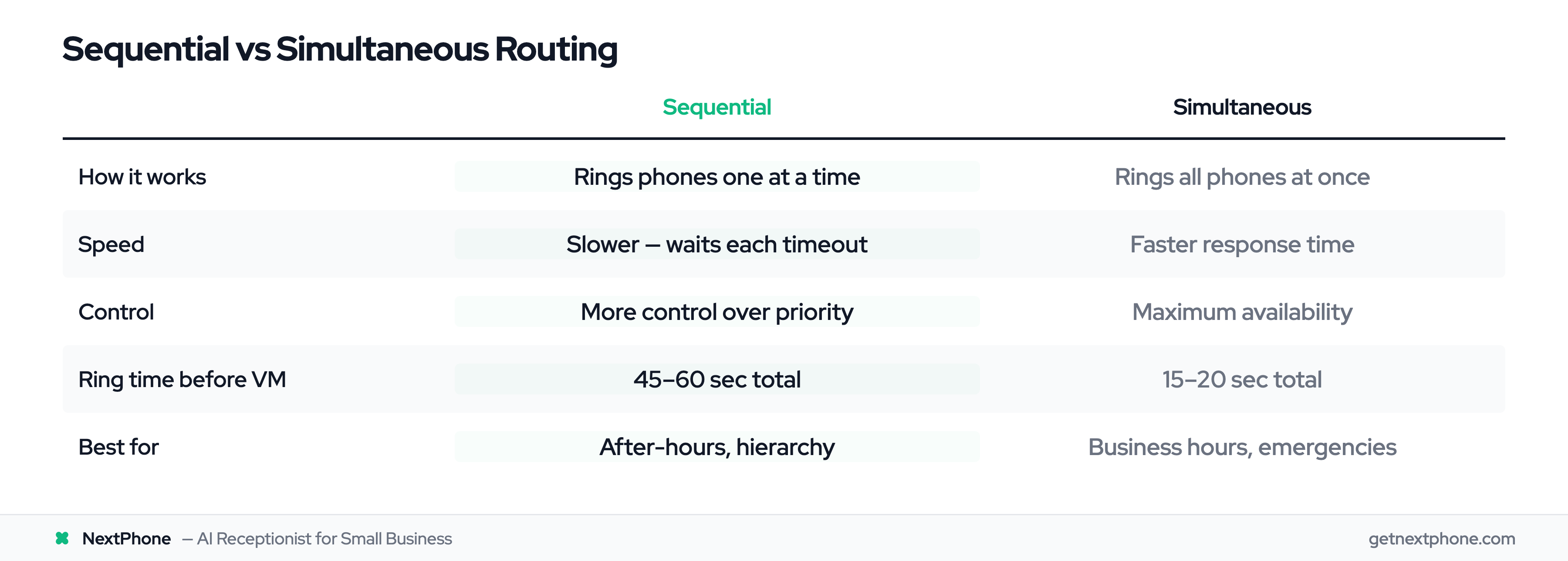
Once you've decided to forward calls, you need to choose how they're routed to multiple destinations. Two strategies exist: sequential and simultaneous.
Sequential Call Forwarding (Ring in Order)
Sequential ringing forwards calls to numbers one at a time in a preset order. Your business line rings first. If unanswered after 15-30 seconds, it forwards to your mobile. Still no answer? It rings your office phone. Finally, it goes to voicemail.
This creates a hierarchy. You control exactly who gets the call first, second, and third.
Sequential works well for solo businesses or when you have a preferred contact order. A plumber might set: mobile phone (15 sec) — office line (15 sec) — voicemail. This ensures they get first shot at answering, but calls don't get lost if they're under a house fixing pipes.
The downside? Speed. Each number rings for the configured time before moving to the next. Total time before voicemail can be 45-60 seconds. Some customers hang up before the chain completes.
Simultaneous Ringing (Ring All at Once)
Simultaneous ringing does exactly what it sounds like — all designated phones ring at once. Your desk phone, mobile, and partner's phone all ring together. Whoever answers first gets the call. The other phones stop ringing.
Simultaneous ringing minimizes unanswered calls and reduces response time. Instead of waiting for three sequential 20-second ring cycles, all phones ring immediately. First available person picks up.
This works best for teams, urgent calls, and maximizing availability. A service business with three technicians can have all their phones ring. Whoever's available answers — whether they're at the shop, in the truck, or on another job site.
Choosing the Right Strategy for Your Business
Most businesses don't choose one or the other — they use both strategically.
A typical hybrid setup:
- During business hours (9-5): Simultaneous ring to whole team — maximize coverage
- After hours (5pm-9am): Sequential to on-call person — manager — AI receptionist — respect hierarchy
- Weekends: Sequential to emergency-only mobile — AI receptionist
Here's a comparison to help you decide:
| Feature | Sequential | Simultaneous |
|---|---|---|
| How it works | Rings phones one at a time in order | Rings all phones at once |
| Speed | Slower (waits for each timeout) | Faster response time |
| Control | More control over call priority | Maximum availability |
| Best for | Solo businesses, preferred routing | Teams, urgent calls, sales |
| Typical ring time | 15-30 sec per number | All ring until answered |
| When to use | After-hours, hierarchy needed | Business hours, emergencies |
An HVAC company averaging 42 calls per month found that switching from sequential to simultaneous during business hours cut their missed-call rate dramatically. The difference? Calls reached someone in 10 seconds instead of 40.
Time-Based Call Routing: Business Hours vs After-Hours
The best call forwarding setup changes automatically based on time. You don't want the same routing at 10 AM on Tuesday as you do at 10 PM on Saturday.
How Time-Based Routing Works
Time-based routing automatically changes your forwarding rules based on a schedule. You set it once, and it handles the rest.
During business hours, calls might ring your desk phone or the entire team simultaneously. After 5 PM, they forward to an on-call mobile. Weekends route to the AI, which captures the message and patches through emergencies.
Modern VoIP and cloud phone systems make this easy. Traditional carriers offer limited time-based features — you might need to manually activate/deactivate forwarding with codes like *72 and *73. Newer systems (and an AI receptionist with built-in business hours) let you configure detailed schedules once and forget them.
Setting Up Business Hours Rules
A practical business hours setup for a contractor:
Monday-Friday, 8 AM - 6 PM:
- Simultaneous ring: Office phone + Mobile
- Ring time: 20 seconds
- If unanswered: Forward to AI receptionist
Monday-Friday, 6 PM - 8 AM:
- Forward directly to AI receptionist
- AI captures the lead, books if possible, transfers true emergencies to on-call mobile
Saturday:
- Forward to mobile
- Ring time: 15 seconds
- If unanswered: AI receptionist
Sunday:
- All calls to AI receptionist
- Emergencies transferred to on-call technician; everything else captured for Monday
After-Hours and Holiday Routing
A large share of inbound calls come in outside business hours, and those callers often have the highest intent — they're actively dealing with a problem right now. Emergencies — a pipe burst, no power, AC out in 95-degree heat — can happen at 2 AM on a Sunday. You need a way to handle them without being woken up by every spam call.
The solution: conditional forwarding into an AI receptionist with emergency detection. The AI identifies urgency and routes accordingly. A call saying "My basement is flooding!" gets transferred to your cell immediately. A call asking "What are your hours?" gets answered on the spot — no callback needed, no interruption to you.
A production after-hours call — the AI greets, captures the issue and contact details, and flags it for callback. This is the call a voicemail box loses at 9 PM.
Time-based routing also prepares you for peak and slow periods. An HVAC company might route more calls to the AI during summer when field techs are slammed with AC emergencies. In winter, calls can ring the office longer since scheduling is slower.
Failover Forwarding: Backup Routing When Primary Fails
You've set up perfect call forwarding. Calls ring your mobile, then your office, then the AI. Then your mobile loses signal in a basement. Or your VoIP system has an internet outage. Without failover, calls fail.
What is Failover Forwarding
Failover forwarding automatically routes calls to a backup number if the primary destination is unreachable, busy, or rejected. It's your safety net.
Think of it as routing insurance. If the first number can't accept the call for any reason, the system immediately tries the next destination. No dropped calls. No lost opportunities.
Common Failover Scenarios
Situations where failover saves calls:
- Phone is powered off
- No cell signal (basement, rural area, elevator)
- Line is busy and you can't accept waiting calls
- Internet outage affecting a VoIP system
- Primary number's voicemail is full
Without failover, these scenarios result in a fast busy signal or a "this number cannot be reached" message. The caller hangs up and calls your competitor.
With failover, the call instantly routes to your secondary number. The customer doesn't even know there was a problem.
Setting Up Multi-Tier Failover
Best practice: don't rely on just one backup. Set up multiple tiers.
Example multi-tier failover:
- Primary: Office VoIP line
- Secondary: Owner's mobile
- Tertiary: Partner's mobile
- Final: AI receptionist (answers, captures, routes)
If the VoIP system is down (internet outage), calls go to the owner's mobile. If that's unreachable (no signal), they route to the partner. If both are unavailable, the AI catches the call — so even your last resort still answers and captures the lead instead of dumping to a voicemail box.
Approximately one in four callers explicitly requests a callback when they reach your business. Without a system that captures these calls and their details, most fall through the cracks. As one contractor told us: "I didn't even know I was missing that many calls until I saw the data. I just thought business was slow."
Test your failover regularly. Turn off your primary phone and call your business line. Does it route to backup? How long does it take? Monthly testing prevents surprises.
Voicemail Integration: The Final Failsafe
Voicemail should be the last destination in your forwarding chain, not the first. Better yet, replace it with an AI receptionist that does everything voicemail does — and actually helps the caller.
When Calls Should Go to Voicemail
Voicemail serves two purposes in a forwarding setup:
- Final backup when no human answers across all forwarding destinations
- Intentional routing for after-hours non-emergency calls
A typical flow: business line — forwarded number(s) — voicemail (or AI). Every call attempts to reach a human first. Only calls that can't reach anyone end up at the final destination.
This is the opposite of what most small businesses do — letting everything go straight to voicemail and hoping they check it regularly. The real comparison isn't AI vs human; it's AI vs voicemail. Without AI, missed calls go unanswered. With AI, 90–95% of calls get resolved immediately, and the rest get smart-routed to your phone with full context.
Ring Time Configuration
Ring time matters. If your forwarded number rings too long, callers hang up before anyone answers.
Bad setup: mobile rings 30 seconds, then office phone rings 30 seconds, then voicemail. Total wait: 60+ seconds. Most callers hang up by 40 seconds.
Good setup: simultaneous ring mobile + office for 15 seconds, then forward to the AI. Total wait before someone answers: 15 seconds.
The sweet spot: 15-20 seconds of ring time per destination. Total time before the AI or voicemail catches the call should stay under 45 seconds.
Some businesses skip voicemail entirely. After-hours calls forward to an answering service or an AI receptionist instead. Emergency calls ring until answered with no voicemail option.
Modern Solution: AI Screening + Intelligent Forwarding
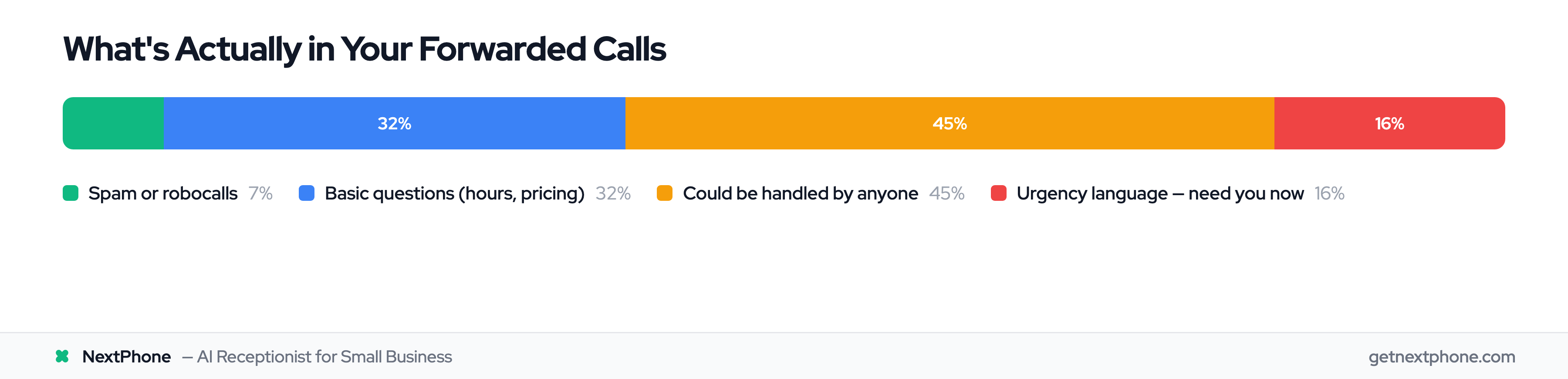
Traditional call forwarding has a problem: it forwards everything.
Every spam call. Every "What are your hours?" question. Every robocall about extended car warranties. All forwarded to your phone while you're on a roof, under a house, or with a client.
The Problem with Traditional Forwarding
You set up call forwarding to never miss opportunities. Instead, you're interrupted dozens of times a month for calls that don't need you.
Across the inbound calls our AI receptionist answers, the most common reasons people call — in ranked order — are: (1) booking or rescheduling an appointment, (2) asking about a specific service or repair, (3) requesting a quote or estimate, (4) checking status of existing work, (5) hours and location, (6) new-customer inquiries, and (7) emergencies. Most of those don't need you personally — but a few absolutely do. Traditional forwarding can't tell the difference between "My basement is flooding!" and "Can you email me a quote?"
How AI Pre-Screens Before Transferring
NextPhone's voice AI receptionist answers every call first, qualifies it, then transfers only the calls that need a human.
Here's how it works:
A customer calls asking about your hours. The AI answers: "We're open Monday through Friday, 8 AM to 6 PM, and Saturday 9 to 3. Would you like to schedule an appointment?" No forwarding needed. No interruption. The customer gets their answer in seconds.
A homeowner calls saying "My basement is flooding, I need help NOW!" The AI detects the emergency and immediately transfers to your mobile with context: "Emergency call — flooding situation — transferring now."
You only get interrupted for calls that actually need you. Spam and robocalls are filtered out before any of that — the AI doesn't ring you on the extended-car-warranty calls.
Real Results from Home Services Contractors
The hybrid approach combines the best of both: 24/7 availability without constant interruptions.
What the AI handles automatically:
- Hours and location questions
- Pricing for standard services
- Appointment scheduling
- Callback requests
- Spam filtering — robocalls never reach you
What transfers to you:
- Emergency situations
- Complex technical questions
- Sales opportunities over a value you set
- VIP customers (configurable)
Cost comparison: traditional call forwarding is typically included in your phone plan — but it forwards everything. A traditional answering service charges $500-800/month for around 100 calls. NextPhone costs $199/month flat for unlimited inbound calls — no per-minute, per-call, or overage fees — with AI screening plus intelligent forwarding built in.
For a contractor missing 31 calls per month (74.1% of 42 — Invoca data), that's potentially $21,700 in lost revenue. Across 1,446,980+ real business calls answered, NextPhone resolves 90–95% of calls without human escalation, picks up in under 5 seconds, and maintains 99% positive caller sentiment. It captures those calls while cutting your interruptions to the handful that actually need you. NextPhone is also natively integrated with Clio and HubSpot, and connects to 6,000+ other tools via Zapier, so a captured lead lands in your CRM automatically. It supports 9 languages out of the box, handling each call in the language the caller speaks.
Frequently Asked Questions
Can I forward calls to my NextPhone number from any carrier?
Yes. Your NextPhone number is just a regular phone number, so any carrier or provider can forward to it — Verizon, AT&T, T-Mobile, Google Fi, MVNOs, VoIP lines like RingCentral or OpenPhone, or a traditional landline. You don't switch carriers and you don't have to port your number. You point your existing line at your NextPhone number using your carrier's forwarding codes or app, and the AI answers from there.
Can I forward multiple business numbers into one AI receptionist?
Yes — forward as many numbers as you want into a single NextPhone number. A main line, an after-hours number, a Google Voice number, and an old landline can all ring the same AI receptionist, trained on your business with one set of hours, intake questions, and routing rules. Every call gets answered the same way regardless of which line it came in on.
How do I activate conditional call forwarding?
On most GSM carriers (AT&T, T-Mobile, and the MVNOs on those networks), dial **004*<number># to forward every call you don't pick up — busy, no answer, or unreachable — then ##004# to turn it off. If you'd rather your phone ring a few times first, use **61*<number>*11*<seconds># instead (each 5 seconds is about one ring, so 20 ≈ four rings) and ##61# to disable. Verizon and CDMA lines use the *71/*72 family, and VoIP providers configure forwarding in their app. On an iPhone, turn off Live Voicemail (Settings → Phone) first, or the call never forwards. Not sure which codes apply to your line? Open Set up call forwarding in the NextPhone app and pick your carrier — it shows the exact codes.
Does call forwarding cost extra?
It depends on your carrier and plan. Most modern business phone plans include call forwarding at no extra charge. Traditional carriers may charge for forwarding to numbers outside your plan area. VoIP and cloud-based systems typically include all forwarding in the base price. NextPhone is $199/month flat for unlimited inbound calls — no per-minute, per-call, or overage fees — with AI screening and intelligent forwarding included.
Will callers know their call is being forwarded?
No, call forwarding is completely transparent to callers. They hear a normal ringing tone and don't know whether they've reached your primary number or a forwarded destination. When the AI answers, it greets them naturally as your business. If you want to set expectations during a live handoff, the AI can say something like "transferring you to a technician now."
What's the difference between call forwarding and call transfer?
Call forwarding is automatic routing configured in advance — it happens before you even see the call. Call transfer is an action during a live call that moves the caller to another line. NextPhone uses both: forwarding brings the call into the AI, and the AI transfers to a human mid-call when one is needed. Forwarding is "set it and forget it"; transfer is the real-time handoff.
How do I test my call forwarding setup?
Call your business number from a different phone and verify it reaches the right destination — the AI, your mobile, or your office. Test the conditional path by letting it ring without answering to confirm it forwards. Test failover by turning off your primary phone and calling again. Test time-based rules by calling at different times of day. Run these checks monthly to catch carrier resets before customers do.
Can I set up different forwarding for different callers?
Most carriers only support basic conditional forwarding (busy, no-answer, unreachable). Per-caller routing by caller ID is an advanced feature not available on most lines. The better approach: forward calls into an AI receptionist that asks the caller about their needs, then routes accordingly. NextPhone's AI distinguishes emergencies from routine inquiries and applies different routing rules based on urgency and intent — sending the right call to the right place automatically.
Set Up Smart Call Forwarding Today
The 60–80% of calls going unanswered at most small businesses is preventable. Call forwarding setup takes minutes but prevents thousands in lost revenue.
Choose the right type for your needs: conditional forwarding for control, time-based routing for automatic scheduling, sequential for hierarchy, simultaneous for speed, and failover for reliability. The best setups combine all of these strategically — and point them at an AI receptionist that answers first.
The modern approach pairs AI screening with intelligent forwarding. Forward any number, from any carrier, into one AI that answers in under 5 seconds, handles the routine, and transfers to your cell only when a human is needed. You get 24/7 availability without constant interruptions.
Don't let another $4,500 emergency call slip through while you're on a roof. Start your free 7-day trial of NextPhone and forward your first number in minutes.