
Funeral Home Answering Service: Compassionate 24/7 Support for Every Family
Quick answer: A funeral home answering service picks up every inbound call — first calls, removal requests, packages questions, viewing schedules — within seconds, 24/7, with grief-appropriate tone and a clean handoff to your on-call director. Today funeral homes can choose live operators (ASD, Directors' Choice, FuneralCall, Directors' Answering) or an AI receptionist that answers in under 5 seconds at a flat monthly rate. The audio embeds below let you hear an AI handle an after-hours intake, a removal-authorization transfer, and a packages inquiry before you commit.
The phone rings at 2:47 AM. A daughter just lost her mother. She's overwhelmed, frightened, and searching for help. If she reaches your voicemail, she'll call the next funeral home that appears in her Google search. You'll never know she called.
This scenario plays out thousands of times every week across the country. A funeral home answering service exists precisely for these moments — when families need help and your staff can't answer. According to bereavement research, nearly 40% of death notifications occur outside standard business hours.
For funeral homes, every call matters. And the way you answer — or don't — shapes a family's experience during one of their most difficult moments.
This guide covers why funeral homes need specialized answering services, what features actually matter, what real call data tells us about the after-hours window, and how to choose the right solution for your business.
What 1,446,980 real inbound calls reveal about the deathcare window
We process every call through NextPhone's AI receptionist and store the outcome. Pulling the most recent 9 days of inbound traffic (post-2026-05-16 when our outcome taxonomy was finalized) from our production database (1,446,980 inbound calls after spam filtering) showed numbers that confirm what every funeral director already suspects:
Plain voicemail leaks even more — most callers refuse to leave one.
The implication for deathcare: you need pickup in under 5 seconds, an answering layer that works at 2 AM the same way it works at 2 PM, and an intake script that captures the first-call data fields before the caller has a chance to disconnect.
A real after-hours call recorded from our production system.
Why Standard Answering Services Fall Short for Funeral Homes
Generic answering services work fine for appointment reminders and basic message-taking. But funeral homes operate in a different reality. The calls you receive carry emotional weight that most industries never experience.
Death Doesn't Keep Office Hours
Families don't plan when they'll need you. Hospitals call at 3 AM. Nursing home staff reach out on Christmas morning. A son finds his father unresponsive on a Sunday afternoon.
The data confirms what every funeral director already knows: 98% of funeral directors forward their phones after hours because waiting until morning isn't an option.
A missed call doesn't just mean a lost opportunity — it means a grieving family turned to your competitor because no one answered when they needed help most.
The First Call Is Everything

In funeral service, the "first call" represents perhaps the most critical moment in your relationship with a family. This is when they initially contact your funeral home to report a death and seek guidance.
These calls require collecting specific information: the deceased's name and date of birth, current location of the body, next of kin contact details, attending physician information, and authorization for removal. A generic answering service representative has no idea how to handle this conversation.
Here's what makes first calls unique: 96% of families recall the tone and helpfulness of their initial contact with remarkable clarity. Research also shows that 87% of families are more likely to choose funeral services after a compassionate first interaction.
That single phone call — often made at the worst moment of someone's life — determines whether they trust you to care for their loved one.
The Staffing Crisis Makes Support Critical
The funeral industry faces a workforce challenge that's only getting worse. According to the National Funeral Directors Association, more than 60% of funeral directors are expected to retire within the next five years.
Meanwhile, 50% of new funeral directors quit within their first five years due to burnout. The demanding schedules — often nine days on, one day off — take their toll.
Professional answering services help bridge this gap. Rather than expecting already-stretched staff to answer every call around the clock, you can provide coverage without increasing burnout. Your team focuses on families in person while trained professionals handle incoming calls.
What to Look for in a Funeral Home Answering Service
Not all answering services understand the funeral profession. Here's what separates adequate from exceptional.
24/7 Availability Without Exception
Round-the-clock coverage isn't a nice-to-have — it's mandatory. Families need help on Thanksgiving, during snowstorms, at 4 AM on a Tuesday.
When evaluating services, ask specifically about holiday coverage, severe weather protocols, and what happens during high-volume periods. Some services reduce staffing during "slow" times, which can leave families waiting.
The goal is simple: when a family calls your funeral home, someone compassionate and competent answers. Every time.
Compassionate, Trained Operators (or a Tuned AI Voice)
Standard answering service scripts don't work for grieving families. "Thank you for calling, how may I direct your call?" falls flat when someone just lost their spouse.
Look for services that provide specialized training in grief-sensitive communication. Leading funeral answering services train their staff for months — ASD requires six months of extensive training before representatives handle calls independently.
If you're evaluating an AI receptionist, the voice matters more than people expect. A bright, upbeat reception voice that sounds great for a salon is the wrong fit for a removal call. You want a calm, neutral, warm-professional tone. Two examples from our voice library:
A good default for funeral homes that want a tone closer to a hospital chaplain than a hotel front desk.
A second option for funeral homes that want a touch more warmth on the line. Same script, audibly different tone.
The right tone is sympathetic but professional, never overly sad or cheerful. The receptionist — human or AI — should understand cross-cultural mourning practices and religious traditions, speak clearly at an appropriate pace, and make callers feel secure during chaos.
First Call Intake Capability
Your answering service needs to handle first calls properly. This means collecting all essential information accurately:
About the deceased:
- Full legal name
- Date of birth
- Date and time of death
- Social Security Number
- Residence address
Location details:
- Current location of the body (hospital, residence, nursing facility)
- Facility name and phone number
- Whether death was expected or sudden
Next of kin information:
- Name and relationship to deceased
- Phone number and address
- Authorization for removal
Attending physician / certifier information:
- Attending physician name and contact
- Information needed for death certificate
A service that can't handle this intake properly creates problems downstream and may frustrate families who have to repeat information.
A live recording of an AI receptionist running a structured intake — name, contact, scope, urgency — before the caller has a chance to hang up. The same flow handles a packages inquiry, a removal request, or a viewing-schedule question without dropping fields.
Urgent Call Routing and Escalation
Not every call needs to wake you at 2 AM. But some absolutely do.
Effective answering services establish clear protocols for which calls require immediate attention and which can wait until morning. Routine questions about service times or directions don't need escalation. First calls and urgent situations do.
Multiple notification methods matter too. Your on-call director should receive alerts via their preferred channel — phone call, text message, email, or mobile app. The best services offer all options.
Your service needs to identify those calls in real time and escalate. Here's a live transfer in action:
A real call routed live to an on-call staff member. The AI introduces the family, summarizes what they need (removal coordination), and stays on long enough for a clean handoff — what a generic ring-no-answer forward can't do.
Privacy and Compliance
Funeral homes handle sensitive information that requires careful protection. Your answering service must maintain strict privacy practices for the details shared during first calls.
Look for services that use encrypted transport, secure message storage, and staff training on confidentiality. Representatives should understand FTC Funeral Rule provisions (price-disclosure requirements, itemized General Price List handling on inbound pricing questions) and state-specific regulations around death care.
Ask potential vendors directly about their data security practices, retention windows, and who on their team can access the recordings or message transcripts of your inbound calls.
Integration with Your Systems
The best answering services connect with your existing tools rather than creating information silos.
Integration with funeral management software like Passare or FuneralTech means call information flows directly into your systems. CRM connections ensure no details get lost. Email and SMS notifications keep your team informed in real-time.
When evaluating services, ask about their integration capabilities. Some offer HTTP webhooks that connect with virtually any system. Others have built-in connections to common platforms.
For a deeper look at how AI receptionists work for small businesses, including setup and capabilities, check out our complete guide.
Traditional Answering Services vs. AI Receptionists: What's Right for Your Funeral Home?
The answering service market has evolved significantly. Today, funeral homes can choose between traditional live operators or AI-powered solutions with smart forwarding for edge cases.
Traditional Live Answering Services
Companies like ASD (Answering Service for Directors), Directors' Choice, and Map Communications have served funeral homes for decades. More than one-third of all US funeral homes use ASD.
What they do well:
- Human operators who can navigate complex emotional conversations
- Extensive funeral industry experience and training
- Established relationships with the deathcare profession
- Understanding of industry-specific protocols
Where they fall short:
- Higher costs, typically $165–400+ per month, often with per-minute or per-call rates on top
- Per-minute billing models inflate the bill against the natural call shape. Funeral homes are particularly exposed because short routine questions — directions, hours, viewing times — dominate volume
- Quality varies depending on which operator answers
- Limited scalability during sudden call volume spikes (mass-casualty events, severe-weather clusters)
AI-Powered Receptionists
AI answering technology has matured rapidly. Modern AI receptionists can handle natural conversations, collect information accurately, and route calls appropriately.
What they do well:
- Consistent tone and intake quality on every single call — no operator variance
- Flat monthly pricing with no per-minute or per-call surcharges
- True 24/7 coverage that doesn't degrade at night or on holidays
- Pickup in under 5 seconds — meaningful when median caller patience is roughly 14 seconds before they hang up
- Perfect data capture: every first-call field gets logged, every call gets transcribed and timestamped
Where they need support:
- Especially complex or distraught conversations still benefit from a human handoff — which is exactly what smart-forwarding to your on-call director provides
- Requires proper setup and training on your specific business protocols
The key advantage? AI receptionists answer in under 5 seconds.
AI-First with Smart Forwarding Works Best
For most funeral homes, AI-first with smart forwarding for sensitive situations delivers the best results.
AI handles the majority of calls efficiently: inquiries about service times, directions to your facility, general questions about your offerings. It collects first call information accurately and completely.
When situations require human empathy — a caller who's especially distraught, or a complex family situation — smart forwarding transfers seamlessly to your on-call director.
This approach provides consistent 24/7 coverage at a flat monthly rate while ensuring families reach you directly when they truly need it.
What Does a Funeral Home Answering Service Cost?
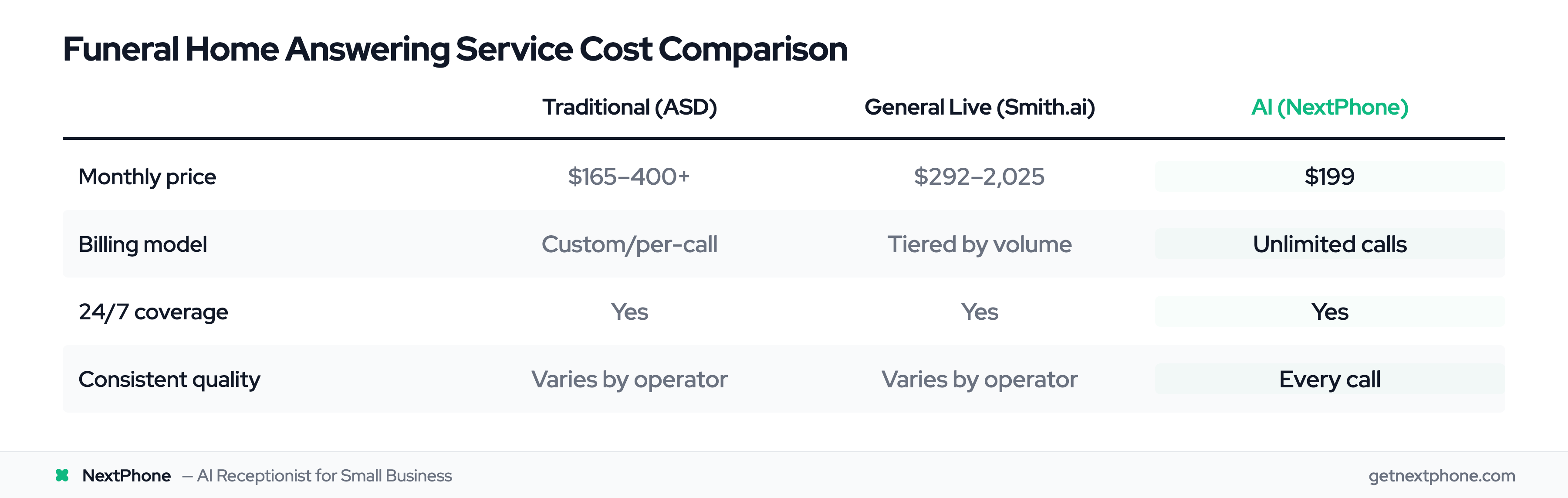
Understanding pricing helps you budget appropriately and compare options fairly.
Typical Pricing Models
Most answering services use one of these structures:
Per-minute billing: Average rate around $1.39 per minute. Simple calls cost less; detailed first calls cost more. The catch: per-minute models usually round up to the next 30 or 60 seconds.
Per-call billing: Ranges from $1.15 for basic message-taking to $2.71+ for complex funeral arrangement calls.
Monthly plans: Fixed monthly fee for a certain number of calls or minutes, with overage charges beyond that.
Research indicates that the average independent funeral home pays approximately $165 per month for answering services.
Comparing Your Options
| Service Type | Price Range | Billing Model |
|---|---|---|
| Traditional funeral-specific (ASD, Directors' Choice) | $165–400+/month | Custom / per-call / per-minute |
| General live answering (Smith.ai) | $292–2,025/month | Tiered by call volume |
| AI-powered (NextPhone) | $199/month | Unlimited calls, flat rate |
ROI Makes Sense Quickly
Here's the math that matters: the average traditional funeral with burial costs families $7,000–12,000. Even cremation services typically run $2,000–5,000.
If your answering service helps you capture just one or two additional arrangements per month that you would have otherwise missed, it pays for itself many times over.
Beyond direct revenue, consider these factors:
- Reduced staff burnout means lower turnover costs
- 40% improvement in staff allocation efficiency reported by funeral homes using professional answering services
- Better work-life balance helps attract and retain employees in a shrinking labor pool
How NextPhone Supports Funeral Home Communication
NextPhone provides AI-powered receptionist services designed for businesses that can't afford to miss calls — including funeral homes that serve families around the clock.
Key Capabilities for Funeral Homes
24/7 AI Receptionist: Your phones are answered every time, day or night, within 5 seconds.
Compassionate Call Handling: NextPhone learns your specific protocols, terminology, and desired tone. Pick the voice that fits your brand (the audio samples above are pulled from our actual production library). The AI handles calls with appropriate sensitivity for families in difficult moments.
Complete First Call Intake: Collect all required information — deceased details, location, next of kin, physician information — accurately and completely. Nothing gets missed or forgotten.
Instant Notifications: Your on-call director receives alerts immediately via text, email, or phone call. You choose the method that works best for your team.
Seamless Transfer: When callers need to speak with someone directly, the AI transfers them to your designated staff member. The handoff is smooth, with context provided about the call — exactly the flow demonstrated in the call-routing audio above.
SMS Follow-Up: Send families automatic text messages with your address, service details, or next steps immediately after their call.
CRM Integration: Every call gets logged automatically with complete information. No more scribbled notes that get lost or details that slip through cracks.
Why Funeral Homes Choose NextPhone
Predictable pricing: $199 per month with unlimited calls.
Fast setup: Get running in hours, not weeks. Provide your business information, customize your greeting and protocols, and start forwarding calls.
Integration flexibility: Connect with your existing systems through HTTP webhooks, SMS, and email notifications.
Bilingual support: Serve families who prefer Spanish or other languages.
Compliant data handling: Family information stays protected with encrypted transport and secure storage.
Frequently Asked Questions About Funeral Home Answering Services
Can an answering service handle a "first call" properly?
Yes, with proper setup and training. Professional funeral answering services — both human and AI-powered — can collect deceased information, current location, next of kin details, and physician contacts. The key is establishing clear protocols and ensuring the service understands what information you need. Urgent calls get routed immediately to your on-call director while all details are documented. Listen to the lead-qualification audio above for an example of structured intake captured live.
How do answering services handle after-hours emergencies?
Time-sensitive calls are forwarded immediately via your preferred method — phone call, text message, email, or mobile app notification. You establish which situations require immediate escalation versus which can wait until morning. Well-designed services include multiple backup notification methods to ensure urgent calls always reach someone quickly.
Is my families' information kept private?
Reputable answering services maintain strict privacy practices with encrypted transport, secure message storage, and trained staff who understand confidentiality requirements. Ask potential vendors specifically about their data handling practices, retention windows, and staff access controls. Your families trust you with sensitive information — your answering service must protect it equally.
What's the difference between a general answering service and one designed for funeral homes?
Funeral-specific services train operators in grief-sensitive communication and understand first call protocols. They know FTC Funeral Rule requirements (including price-disclosure rules on inbound pricing questions) and can navigate conversations with appropriate empathy. General answering services lack this specialized knowledge — their representatives may handle your calls the same way they'd handle calls for a plumbing company or property management office.
How much should I expect to pay?
Most independent funeral homes pay between $165–300 per month for answering services. Traditional per-call services typically charge $1.15–2.71 per call depending on complexity. AI-powered services like NextPhone offer unlimited calls for $199 per month, making costs predictable regardless of call volume.
Will families know they're talking to an AI?
Modern AI receptionists sound natural and conversational. Many callers don't realize they're speaking with AI unless told — listen to the after-hours and lead-qualification clips above for unedited examples. Transparency builds trust, so NextPhone's AI can identify itself while still providing compassionate, helpful service. The experience matters more than whether a human or AI is speaking: families want their calls answered promptly, handled with care, and routed appropriately.
How quickly can I get started?
NextPhone can be set up in a few hours. You provide your business information, customize greetings and call handling protocols, and configure where to route different types of calls. Then forward your phones and start receiving coverage immediately. No lengthy contracts, extensive onboarding processes, or weeks of setup required.
Why does call answer speed matter so much for funeral homes?
Most callers decide whether to stay on the line in the first few rings. If your line takes 15 seconds to answer, half your callers are already gone. Industry research on hold times converges on the same conclusion — answer inside 3 rings or expect significant drop-off.
Give Every Family the Compassion They Deserve
Funeral homes exist to serve families during their most difficult days. Every call represents someone who needs guidance, comfort, and professional help navigating loss.
The math from our own database is clear:
Combine that with the human data: 96% of families remember their first interaction with a funeral home, and 87% are more likely to choose you after a compassionate first call. A professional answering service costs a fraction of what additional staff would. Just one or two extra arrangements per month covers the entire investment. Families get compassionate help whenever they call. Your team gets sustainable schedules. And you stop losing arrangements to competitors who simply answered the phone.
Every call to your funeral home is from someone experiencing one of their worst days. They deserve compassion, competence, and immediate help — at 2 PM or 2 AM.